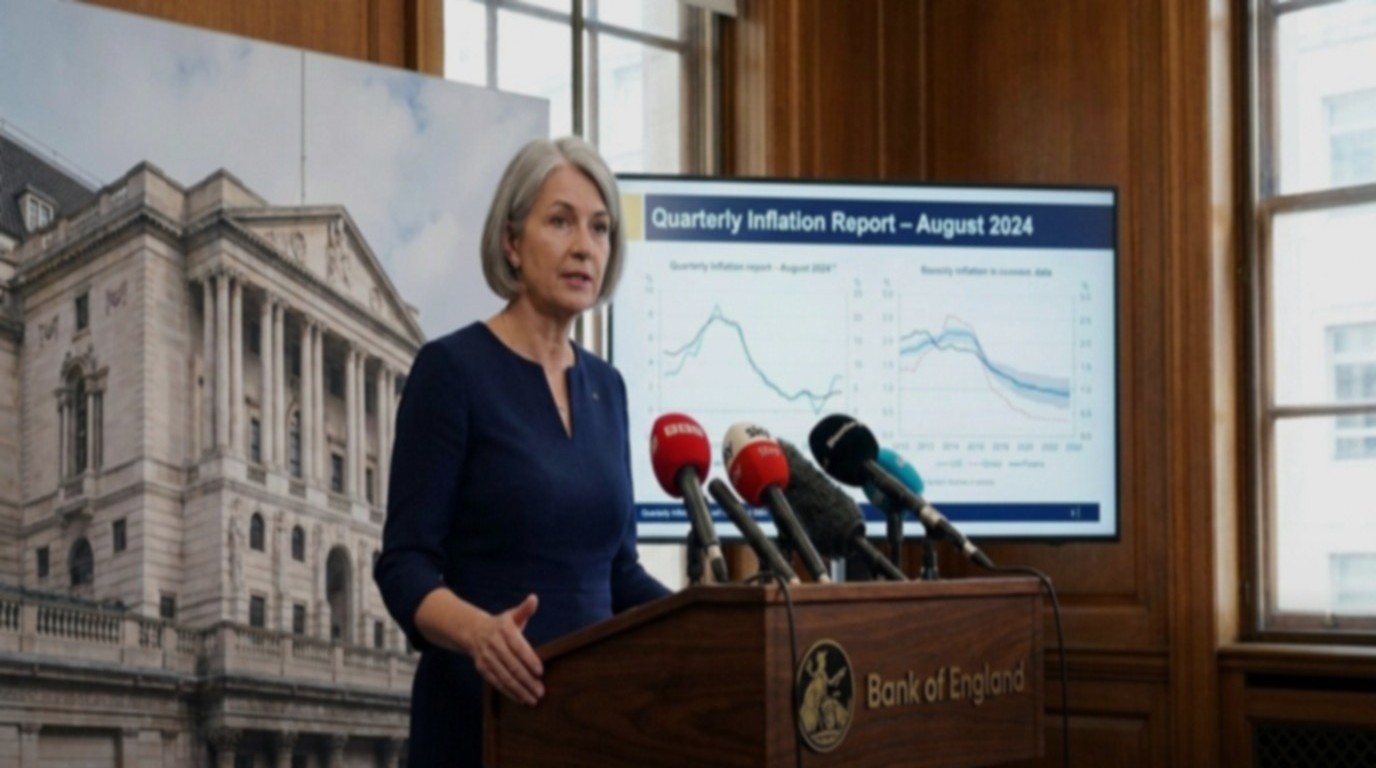
Deputy Governor Sarah Breeden used the launch of the Bank of England's Quarterly Bulletin to argue that, while goods disinflation has been a remarkable success, the services component of the basket is the one that will determine the timing of the next cut.
The Bank of England's Quarterly Bulletin, published on Thursday, contains a number of striking charts. One in particular caught the eye of the press gallery: a decomposition of the inflation print into its goods and services components, plotted from 2019 to the present, with the goods line falling sharply while the services line refuses to budge. It is, in effect, the visual summary of the entire UK monetary policy debate of the last 18 months.
Presenting the Bulletin, Deputy Governor Sarah Breeden — who, as the Bank's executive director for financial stability, has been an increasingly prominent voice on the Monetary Policy Committee — said services inflation was "the live question" for policy. "Goods disinflation has done more of the work than most people expected," she said. "The question now is whether services follows it down, and on what timetable."
What the Bulletin says
The Bulletin argues that the persistent gap between goods and services inflation reflects a combination of three factors: the relative stickiness of wages in services, the pass-through of past energy shocks into non-tradable prices, and the post-pandemic shift in consumer spending from goods towards services. Of the three, the Bulletin suggests, wage settlements are the most important — and the most uncertain.
The Bank's staff model now assumes that pay growth will converge on a rate of 3.7 per cent by the end of 2026, broadly consistent with the inflation target. But the Bulletin flags considerable uncertainty around this central case, with a fan chart showing a 30 per cent probability of pay growth remaining above 4.5 per cent through the second half of next year.
Why the BoE is watching pay
Breeden spent a significant portion of the press conference walking reporters through the Bank's preferred measures of pay growth — the three-month average of regular pay, the Agent Pay Panel, the Decision Maker Panel and the REC survey — and why none of them, taken alone, provides a reliable read on underlying wage pressure. The Bulletin introduces a new composite indicator that averages the four, weighted by their historical reliability, which the Bank will begin to use in its communications from December.
The composite indicator currently stands at 4.6 per cent, broadly unchanged from the previous Bulletin but with a clear downward bias over the last two prints. The Bank's view, Breeden said, is that the "trend is in the right direction, but the level is still uncomfortable."
The supply-side view
In a new section of the Bulletin, the Bank's staff present evidence on the supply side of the UK economy. They argue that the weakness of productivity growth since the pandemic reflects, in roughly equal measure, a fall in business investment, a deterioration in the skill mix of the workforce, and a persistent post-Covid hangover in some service sectors. The conclusion is that the UK's supply-side problems are "structural rather than cyclical" and that demand-side stimulus, in the form of looser monetary policy, "should not be expected to fix them."
The framing is significant because it forecloses one of the more politically attractive arguments for an aggressive cutting cycle — that a rate cut would, by stimulating demand, somehow unlock the supply side. The Bank's view, in effect, is that the supply side needs to be fixed by other means: tax reform, planning liberalisation, skills and infrastructure investment. Monetary policy can hold the ring; it cannot, on its own, deliver higher trend growth.
What markets took away
Markets read the Bulletin as, on balance, slightly more hawkish than expected. Two-year gilt yields rose three basis points to 3.94 per cent, and sterling ticked up 0.2 per cent against the dollar. The pricing of a February rate cut moved from 47 per cent to 41 per cent, although the market still expects the Bank Rate to be 4.25 per cent by the end of next year.
The Bulletin will, of course, be read with one eye on the next set of labour market data, due the week before the December meeting. If pay growth prints below 4.5 per cent on the three-month measure, the market will take it as a signal that the Bank is moving closer to a cut. If it doesn't, the path is likely to be a slower one than the OBR currently assumes.