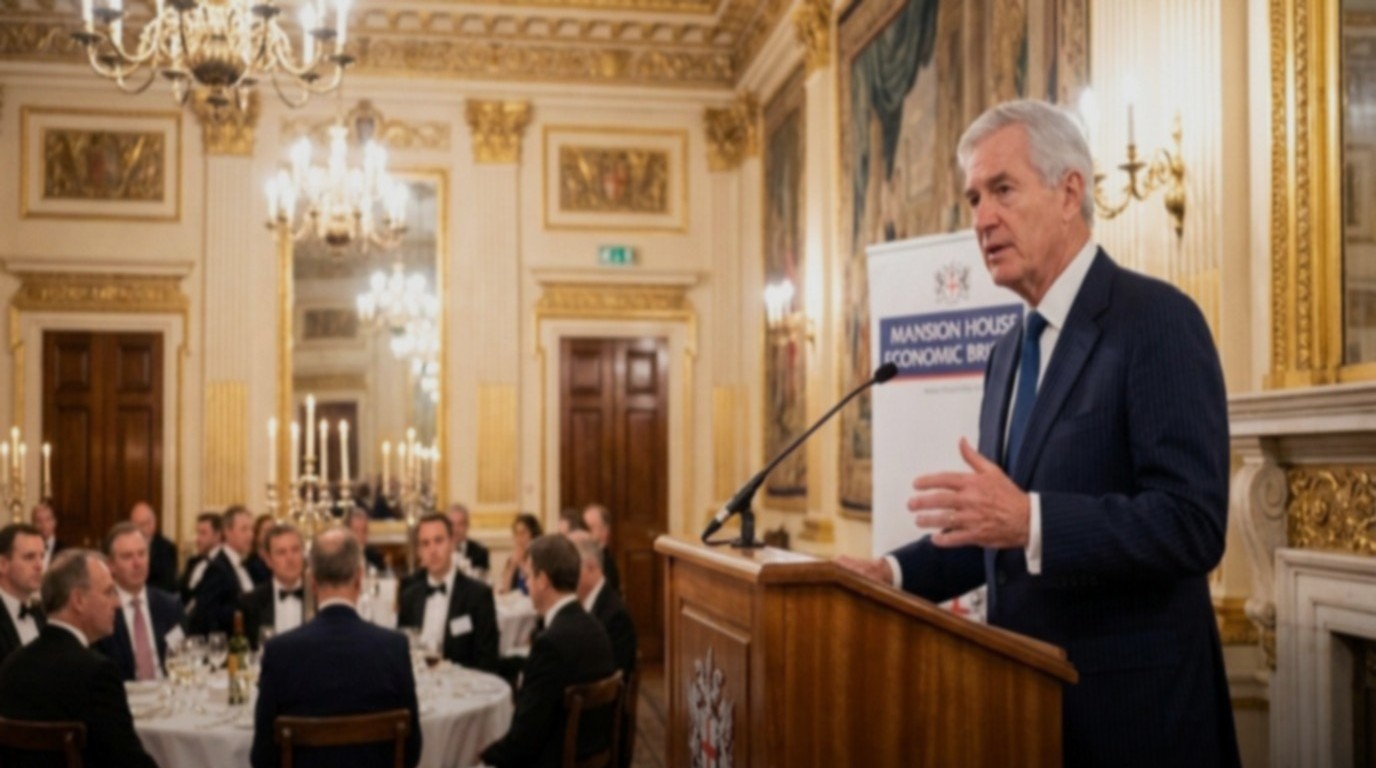
Beneath the chandeliers of the Mansion House, the Chancellor used the Lord Mayor's annual banquet to argue that British pension savers are sitting on the most under-used pool of long-dated capital in the developed world — and that the City has the tools to put it to work.
The Mansion House Banquet is, by tradition, the moment in the British financial year when the Chancellor and the Governor of the Bank of England set out, to an audience of twelve hundred City grandees, what they want the City to be doing over the twelve months ahead. On Thursday evening, Rachel Reeves and Andrew Bailey used the occasion to argue, in unusually complementary terms, that the United Kingdom's £2.3 trillion of defined-contribution pension assets represent the most under-used pool of long-dated capital in the developed world — and that the City has the tools, and the duty, to put them to work.
The Chancellor's centrepiece was a 10-year plan to consolidate the country's increasingly fragmented defined-contribution market into a small number of "megafunds" of at least £50bn in scale. The plan, drawn up jointly with the Department for Work and Pensions, will see the government consult on a default consolidator regime over the first half of 2026, with the first wave of consolidations expected to complete in 2027.
The argument
The case, in brief, is that scale unlocks investment in less liquid and higher-returning assets — private credit, infrastructure, venture and growth equity — which in turn deliver better retirement outcomes and a more productive economy. The Treasury cites Australian and Canadian pension funds as evidence that scale funds can deliver materially higher returns than small schemes, while arguing that the UK has been left behind by a fragmentation that has seen more than 90 separate master trusts compete for default enrolment.
The British Business Bank, the National Wealth Fund and the UK Infrastructure Bank will act as anchor investors for the new vehicles, providing a "patient capital" layer that the Chancellor said would be "the seed from which a deeper market for UK growth assets grows."
What the Governor said
In his customary accompanying speech, the Governor of the Bank of England said the Bank would "respond positively" to a Treasury and Pensions Regulator request for the PRA to consider modifications to its matching rules to enable scale funds to invest in less liquid assets. He also confirmed that the Bank would, by Easter, publish a discussion paper on the case for a "sovereign-backed" infrastructure investment vehicle — the so-called "British ISA" idea, in a new guise.
Reaction: a quiet City yes
Reaction in the City has been broadly supportive, if carefully measured. The Investment Association, which represents the UK's fund management industry, said it "warmly welcomed" the Chancellor's focus on scale and would engage constructively with the consultation. The Pensions and Lifetime Savings Association went further, describing the proposals as "the most important change to UK retirement saving in a generation."
There are, of course, hard questions to come. Trade unions, which are protective of defined-benefit legacy schemes, will want assurances that the new vehicles are not used as a back-door mechanism to redirect employer contributions. Smaller master trusts, which have invested heavily in building their businesses over the last decade, will press for fair treatment in any consolidation. And the Treasury will need to satisfy the Office for Budget Responsibility that the proposals do not require a fiscal transfer from the public purse.
What the Chancellor didn't say
It was notable, however, what the speech did not contain. There was no announcement on a windfall tax on banks, despite pre-briefing speculation, and no extension of the banker bonus cap, on which the Bank of England and the PRA have been pressing for a year. The Chancellor's silence on both was, in the gilded setting of the Egyptian Hall, a deliberate signal: she intends to be on the side of the City, not at war with it.